pylops.signalprocessing.Convolve1D#
- class pylops.signalprocessing.Convolve1D(dims, h, offset=0, axis=-1, method=None, dtype='float64', name='C')[source]#
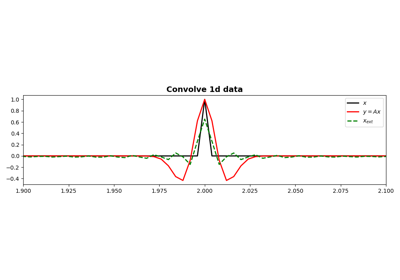
1D convolution operator.
Apply one-dimensional convolution with i) a compact filter (shorter than input signal) or ii) an extended filter (larger than input signal) to model (and data) along an
axisof a multi-dimensional array.- Parameters
- dims
listorint Number of samples for each dimension of the model
- h
numpy.ndarray 1d filter to be convolved to input signal
- offset
int Index of the center of the filter
- axis
int, optional New in version 2.0.0.
Axis along which convolution is applied
- method
str, optional Method used to calculate the convolution (
direct,fft, oroverlapadd). Note that onlydirectandfftare allowed whendims=None, whilstfftandoverlapaddare allowed whendimsis provided.- dtype
str, optional Type of elements in input array.
- name
str, optional New in version 2.0.0.
Name of operator (to be used by
pylops.utils.describe.describe)
- dims
- Raises
- ValueError
If
offsetis bigger thanlen(h) - 1- NotImplementedError
If
methodprovided is not allowed
Notes
The Convolve1D operator applies convolution between the input signal \(x(t)\) and a filter kernel \(h(t)\) in forward model:
\[y(t) = \int\limits_{-\infty}^{\infty} h(t-\tau) x(\tau) \,\mathrm{d}\tau\]This operation can be discretized as follows
\[y[n] = \sum_{m=-\infty}^{\infty} h[n-m] x[m]\]as well as performed in the frequency domain.
\[Y(f) = \mathscr{F} (h(t)) * \mathscr{F} (x(t))\]Convolve1D operator uses
scipy.signal.convolvethat automatically chooses the best domain for the operation to be carried out for one dimensional inputs. The fft implementationscipy.signal.fftconvolveis however enforced for signals in 2 or more dimensions as this routine efficently operates on multi-dimensional arrays.As the adjoint of convolution is correlation, Convolve1D operator applies correlation in the adjoint mode.
In time domain:
\[x(t) = \int\limits_{-\infty}^{\infty} h(t+\tau) x(\tau) \,\mathrm{d}\tau\]or in frequency domain:
\[y(t) = \mathscr{F}^{-1} (H(f)^* * X(f))\]- Attributes
Methods
__init__(dims, h[, offset, axis, method, ...])adjoint()apply_columns(cols)Apply subset of columns of operator
cond([uselobpcg])Condition number of linear operator.
conj()Complex conjugate operator
div(y[, niter, densesolver])Solve the linear problem \(\mathbf{y}=\mathbf{A}\mathbf{x}\).
dot(x)Matrix-matrix or matrix-vector multiplication.
eigs([neigs, symmetric, niter, uselobpcg])Most significant eigenvalues of linear operator.
matmat(X)Matrix-matrix multiplication.
matvec(x)Matrix-vector multiplication.
reset_count()Reset counters
rmatmat(X)Matrix-matrix multiplication.
rmatvec(x)Adjoint matrix-vector multiplication.
todense([backend])Return dense matrix.
toimag([forw, adj])Imag operator
toreal([forw, adj])Real operator
tosparse()Return sparse matrix.
trace([neval, method, backend])Trace of linear operator.
transpose()