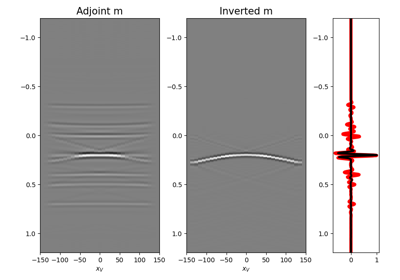
pylops.waveeqprocessing.MDD
-
pylops.waveeqprocessing.MDD(G, d, dt=0.004, dr=1.0, nfmax=None, wav=None, twosided=True, causality_precond=False, adjoint=False, psf=False, dtype='float64', dottest=False, saveGt=True, add_negative=True, smooth_precond=0, fftengine='numpy', **kwargs_solver)[source]¶ Multi-dimensional deconvolution.
Solve multi-dimensional deconvolution problem using
scipy.sparse.linalg.lsqriterative solver.Parameters: - G :
numpy.ndarray Multi-dimensional convolution kernel in time domain of size \([n_s \times n_r \times n_t]\) for
twosided=Falseortwosided=Trueandadd_negative=True(with only positive times) or size \([n_s \times n_r \times 2n_t-1]\) fortwosided=Trueandadd_negative=False(with both positive and negative times)- d :
numpy.ndarray Data in time domain \([n_s \,(\times n_{vs}) \times n_t]\) if
twosided=Falseortwosided=Trueandadd_negative=True(with only positive times) or size \([n_s \,(\times n_{vs}) \times 2n_t-1]\) iftwosided=True- dt :
float, optional Sampling of time integration axis
- dr :
float, optional Sampling of receiver integration axis
- nfmax :
int, optional Index of max frequency to include in deconvolution process
- wav :
numpy.ndarray, optional Wavelet to convolve to the inverted model and psf (must be centered around its index in the middle of the array). If
None, the outputs of the inversion are returned directly.- twosided :
bool, optional MDC operator and data both negative and positive time (
True) or only positive (False)- add_negative :
bool, optional Add negative side to MDC operator and data (
True) or not (False)- operator and data are already provided with both positive and negative sides. To be used only withtwosided=True.- causality_precond :
bool, optional Apply causality mask (
True) or not (False)- smooth_precond :
int, optional Lenght of smoothing to apply to causality preconditioner
- adjoint :
bool, optional Compute and return adjoint(s)
- psf :
bool, optional Compute and return Point Spread Function (PSF) and its inverse
- dtype :
bool, optional Type of elements in input array.
- dottest :
bool, optional Apply dot-test
- saveGt :
bool, optional Save
GandG.Hto speed up the computation of adjoint ofpylops.signalprocessing.Fredholm1(True) or createG.Hon-the-fly (False) Note thatsaveGt=Truewill be faster but double the amount of required memory- fftengine :
str, optional Engine used for fft computation (
numpy,scipyorfftw)- **kwargs_solver
Arbitrary keyword arguments for chosen solver (
scipy.sparse.linalg.cgandpylops.optimization.solver.cgare used as default for numpy and cupy data, respectively)
Returns: - minv :
numpy.ndarray Inverted model of size \([n_r \,(\times n_{vs}) \times n_t]\) for
twosided=Falseor \([n_r \,(\times n_vs) \times 2n_t-1]\) fortwosided=True- madj :
numpy.ndarray Adjoint model of size \([n_r \,(\times n_{vs}) \times n_t]\) for
twosided=Falseor \([n_r \,(\times n_r) \times 2n_t-1]\) fortwosided=True- psfinv :
numpy.ndarray Inverted psf of size \([n_r \times n_r \times n_t]\) for
twosided=Falseor \([n_r \times n_r \times 2n_t-1]\) fortwosided=True- psfadj :
numpy.ndarray Adjoint psf of size \([n_r \times n_r \times n_t]\) for
twosided=Falseor \([n_r \times n_r \times 2n_t-1]\) fortwosided=True
See also
MDC- Multi-dimensional convolution
Notes
Multi-dimensional deconvolution (MDD) is a mathematical ill-solved problem, well-known in the image processing and geophysical community [1].
MDD aims at removing the effects of a Multi-dimensional Convolution (MDC) kernel or the so-called blurring operator or point-spread function (PSF) from a given data. It can be written as
\[\mathbf{d}= \mathbf{D} \mathbf{m}\]or, equivalently, by means of its normal equation
\[\mathbf{m}= (\mathbf{D}^H\mathbf{D})^{-1} \mathbf{D}^H\mathbf{d}\]where \(\mathbf{D}^H\mathbf{D}\) is the PSF.
[1] Wapenaar, K., van der Neut, J., Ruigrok, E., Draganov, D., Hunziker, J., Slob, E., Thorbecke, J., and Snieder, R., “Seismic interferometry by crosscorrelation and by multi-dimensional deconvolution: a systematic comparison”, Geophyscial Journal International, vol. 185, pp. 1335-1364. 2011. - G :