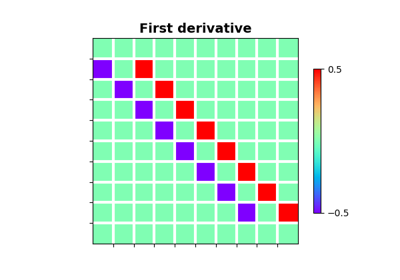
pylops.Gradient
-
pylops.Gradient(dims, sampling=1, edge=False, dtype='float64', kind='centered')[source]¶ Gradient.
Apply gradient operator to a multi-dimensional array.
Note
At least 2 dimensions are required, use
pylops.FirstDerivativefor 1d arrays.Parameters: - dims :
tuple Number of samples for each dimension.
- sampling :
tuple, optional Sampling steps for each direction.
- edge :
bool, optional Use reduced order derivative at edges (
True) or ignore them (False).- dtype :
str, optional Type of elements in input array.
- kind :
str, optional Derivative kind (
forward,centered, orbackward).
Returns: - l2op :
pylops.LinearOperator Gradient linear operator
Notes
The Gradient operator applies a first-order derivative to each dimension of a multi-dimensional array in forward mode.
For simplicity, given a three dimensional array, the Gradient in forward mode using a centered stencil can be expressed as:
\[\mathbf{g}_{i, j, k} = (f_{i+1, j, k} - f_{i-1, j, k}) / d_1 \mathbf{i_1} + (f_{i, j+1, k} - f_{i, j-1, k}) / d_2 \mathbf{i_2} + (f_{i, j, k+1} - f_{i, j, k-1}) / d_3 \mathbf{i_3}\]which is discretized as follows:
\[\begin{split}\mathbf{g} = \begin{bmatrix} \mathbf{df_1} \\ \mathbf{df_2} \\ \mathbf{df_3} \end{bmatrix}\end{split}\]In adjoint mode, the adjoints of the first derivatives along different axes are instead summed together.
- dims :