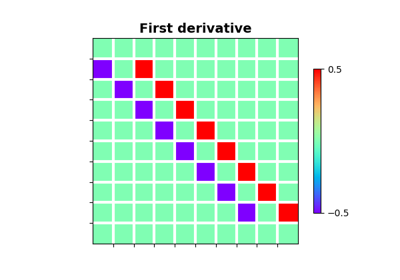
pylops.SecondDirectionalDerivative
-
pylops.SecondDirectionalDerivative(dims, v, sampling=1, edge=False, dtype='float64')[source]¶ Second Directional derivative.
Apply a second directional derivative operator to a multi-dimensional array along either a single common direction or different directions for each point of the array.
Note
At least 2 dimensions are required, consider using
pylops.SecondDerivativefor 1d arrays.Parameters: - dims :
tuple Number of samples for each dimension.
- v :
np.ndarray, optional Single direction (array of size \(n_\text{dims}\)) or group of directions (array of size \([n_\text{dims} \times n_{d_0} \times ... \times n_{d_{n_\text{dims}}}]\))
- sampling :
tuple, optional Sampling steps for each direction.
- edge :
bool, optional Use reduced order derivative at edges (
True) or ignore them (False).- dtype :
str, optional Type of elements in input array.
Returns: - ddop :
pylops.LinearOperator Second directional derivative linear operator
Notes
The SecondDirectionalDerivative applies a second-order derivative to a multi-dimensional array along the direction defined by the unitary vector \(\mathbf{v}\):
\[d^2f_\mathbf{v} = - D_\mathbf{v}^T [D_\mathbf{v} f]\]where \(D_\mathbf{v}\) is the first-order directional derivative implemented by
pylops.SecondDirectionalDerivative.This operator is sometimes also referred to as directional Laplacian in the literature.
- dims :