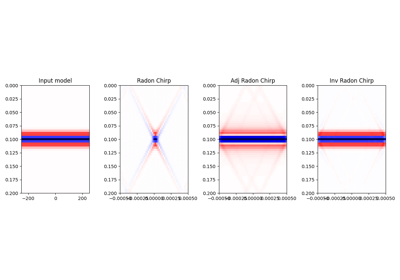
pylops.signalprocessing.ChirpRadon2D
-
class
pylops.signalprocessing.ChirpRadon2D(taxis, haxis, pmax, dtype='float64')[source]¶ 2D Chirp Radon transform
Apply Radon forward (and adjoint) transform using Fast Fourier Transform and Chirp functions to a 2-dimensional array of size \([n_x \times n_t]\) (both in forward and adjoint mode).
Note that forward and adjoint are swapped compared to the time-space implementation in
pylops.signalprocessing.Radon2Dand a direct inverse method is also available for this implementation.Parameters: - taxis :
np.ndarray Time axis
- haxis :
np.ndarray Spatial axis
- pmax :
np.ndarray Maximum slope defined as \(\tan\) of maximum stacking angle in \(x\) direction \(p_\text{max} = \tan(\alpha_{x, \text{max}})\). If one operates in terms of minimum velocity \(c_0\), set \(p_{x, \text{max}}=c_0 \,\mathrm{d}y/\mathrm{d}t\).
- dtype :
str, optional Type of elements in input array.
Notes
Refer to [1] for the theoretical and implementation details.
[1] Andersson, F and Robertsson J. “Fast \(\tau-p\) transforms by chirp modulation”, Geophysics, vol 84, NO.1, pp. A13-A17, 2019. Attributes: Methods
__init__(taxis, haxis, pmax[, dtype])Initialize this LinearOperator. adjoint()Hermitian adjoint. apply_columns(cols)Apply subset of columns of operator cond([uselobpcg])Condition number of linear operator. conj()Complex conjugate operator div(y[, niter, densesolver])Solve the linear problem \(\mathbf{y}=\mathbf{A}\mathbf{x}\). dot(x)Matrix-matrix or matrix-vector multiplication. eigs([neigs, symmetric, niter, uselobpcg])Most significant eigenvalues of linear operator. inverse(x)matmat(X)Matrix-matrix multiplication. matvec(x)Matrix-vector multiplication. rmatmat(X)Matrix-matrix multiplication. rmatvec(x)Adjoint matrix-vector multiplication. todense([backend])Return dense matrix. toimag([forw, adj])Imag operator toreal([forw, adj])Real operator tosparse()Return sparse matrix. trace([neval, method, backend])Trace of linear operator. transpose()Transpose this linear operator. - taxis :