 PyLops
pylops.Sum
- class pylops.Sum(dims, axis=-1, forceflat=None, dtype='float64', name='S')[source]
Sum operator.
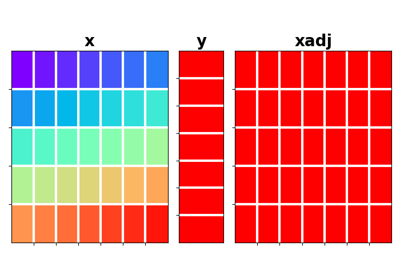
Sum along
axisof a multi-dimensional array (at least 2 dimensions are required) in forward model, and spread along the same axis in adjoint mode.- Parameters:
- dims
tuple Number of samples for each dimension
- axis
int, optional Added in version 2.0.0.
Axis along which model is summed.
- forceflat
bool, optional Added in version 2.2.0.
Force an array to be flattened after rmatvec. Note that this is only required when len(dims)=2, otherwise pylops will detect whether to return a 1d or nd array.
- dtype
str, optional Type of elements in input array.
- name
str, optional Added in version 2.0.0.
Name of operator (to be used by
pylops.utils.describe.describe)
- dims
- Attributes:
Notes
Given a two dimensional array, the Sum operator re-arranges the input model into a multi-dimensional array of size
dimsand sums values alongaxis:\[y_j = \sum_i x_{i, j}\]In adjoint mode, the data is spread along the same direction:
\[x_{i, j} = y_j \quad \forall i=0, N-1\]Methods
__init__(dims[, axis, forceflat, dtype, name])adjoint()apply_columns(cols)Apply subset of columns of operator
cond([uselobpcg])Condition number of linear operator.
conj()Complex conjugate operator
div(y[, niter, densesolver])Solve the linear problem \(\mathbf{y}=\mathbf{A}\mathbf{x}\).
dot(x)Matrix-matrix or matrix-vector multiplication.
eigs([neigs, symmetric, niter, uselobpcg])Most significant eigenvalues of linear operator.
matmat(X)Matrix-matrix multiplication.
matvec(x)Matrix-vector multiplication.
reset_count()Reset counters
rmatmat(X)Matrix-matrix multiplication.
rmatvec(x)Adjoint matrix-vector multiplication.
todense([backend])Return dense matrix.
toimag([forw, adj])Imag operator
toreal([forw, adj])Real operator
tosparse()Return sparse matrix.
trace([neval, method, backend])Trace of linear operator.
transpose()