 PyLops
🎮 GPU / TPU Support
Overview
From v1.12.0, PyLops supports computations on GPUs powered by
CuPy (cupy-cudaXX>=13.0.0).
This library must be installed before PyLops is installed.
From v2.3.0, PyLops supports also computations on GPUs/TPUs powered by
JAX.
This library must be installed before PyLops is installed.
Note
Set environment variables CUPY_PYLOPS=0 and/or JAX_PYLOPS=0 to force PyLops to ignore
cupy and jax backends. This can be also used if a previous version of cupy
or jax is installed in your system, otherwise you will get an error when importing PyLops.
Apart from a few exceptions, all operators and solvers in PyLops can
seamlessly work with numpy arrays on CPU as well as with cupy/jax arrays
on GPU. For CuPy, users simply need to consistently create operators and
provide data vectors to the solvers, e.g., when using
pylops.MatrixMult the input matrix must be a
cupy array if the data provided to a solver is also cupy array.
For JAX, apart from following the same procedure described for CuPy, the PyLops operator must
be also wrapped into a pylops.JaxOperator.
See below for a comphrensive list of supported operators and additional functionalities for both the
cupy and jax backends.
Install dependencies
GPU-enabled development environments can created using conda
>> make dev-install_conda_gpu
or pip
>> make dev-install_gpu
Examples
Let’s now briefly look at some use cases.
End-to-end GPU powered inverse problems
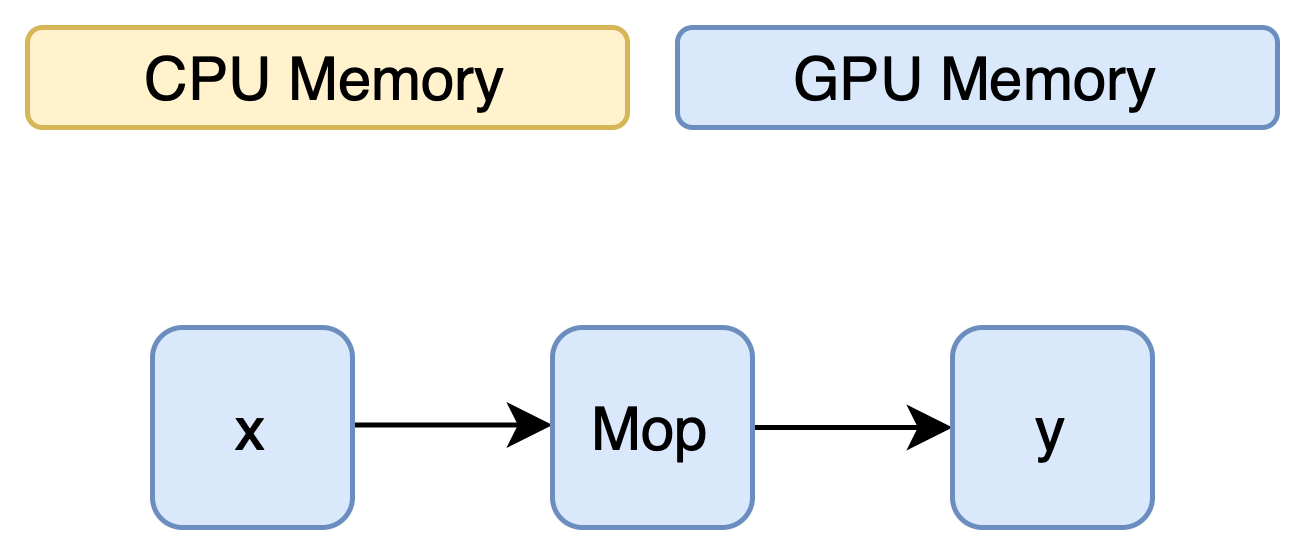
First we consider the most common scenario when both the model and data
vectors fit onto the GPU memory. We can therefore simply replace all our
numpy arrays with cupy arrays and solve the inverse problem of
interest end-to-end on the GPU.
Let’s first write a code snippet using numpy arrays, which PyLops
will run on your CPU:
ny, nx = 400, 400
G = np.random.normal(0, 1, (ny, nx)).astype(np.float32)
x = np.ones(nx, dtype=np.float32)

# Create operator
Gop = MatrixMult(G, dtype='float32')

# Create data and invert
y = Gop @ x
xest = Gop / y
Now we write a code snippet using cupy arrays, which PyLops will run on
your GPU:
ny, nx = 400, 400
G = cp.random.normal(0, 1, (ny, nx)).astype(np.float32)
x = cp.ones(nx, dtype=np.float32)

# Create operator
Gop = MatrixMult(G, dtype='float32')

# Create data and invert
y = Gop @ x
xest = Gop / y
The code is almost unchanged apart from the fact that we now use cupy arrays,
PyLops will figure this out.
Similarly, we write a code snippet using jax arrays which PyLops will run on
your GPU/TPU:
ny, nx = 400, 400
G = jnp.array(np.random.normal(0, 1, (ny, nx)).astype(np.float32))
x = jnp.ones(nx, dtype=np.float32)

# Create operator
Gop = JaxOperator(MatrixMult(G, dtype='float32'))

# Create data and invert
y = Gop @ x
xest = Gop / y

# Adjoint via AD
xadj = Gop.rmatvecad(x, y)
Again, the code is almost unchanged apart from the fact that we now use jax arrays.
Mixed CPU-GPU powered inverse problems
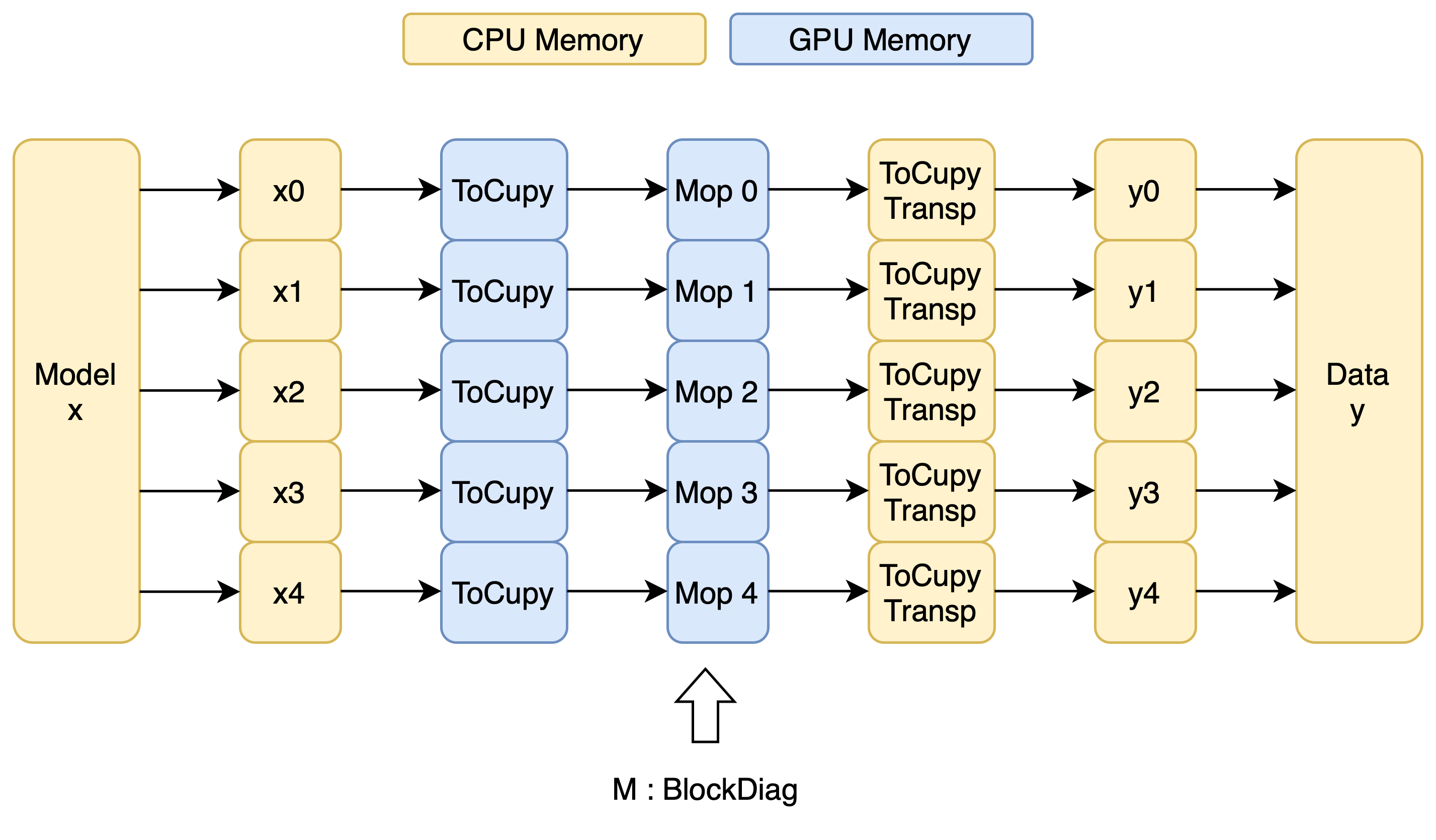
Let us now consider a more intricate scenario where we have access to a GPU-powered operator, however the model and/or data vectors are too large to fit onto the GPU memory (or VRAM).
For the sake of clarity, we consider a problem where
the operator can be written as a pylops.BlockDiag of
PyLops operators. Note how, by simply sandwiching any of the GPU-powered
operator within two pylops.ToCupy operators, we are
able to tell PyLops to transfer to the GPU only the part of the model vector
required by a given operator and transfer back the output to the CPU before
forming the combine output vector (i.e., the output vector of the
pylops.BlockDiag).
nops, n = 5, 4
Ms = [np.diag((i + 1) * np.ones(n, dtype=dtype)) \
         for i in range(nops)]
Ms = [M.T @ M for M in Ms]

# Create operator
Mops = []
for iop in range(nops):
   Mop = MatrixMult(cp.asarray(Ms[iop], dtype=dtype))
   Top = ToCupy(Mop.dims, dtype=dtype)
   Top1 = ToCupy(Mop.dimsd, dtype=dtype)
   Mop = Top1.H @ Mop @ Top
   Mops.append(Mop)
Mops = BlockDiag(Mops, forceflat=True)

# Create data and invert
x = np.ones(n * nops, dtype=dtype)
y = Mops @ x.ravel()
xest = Mops / y
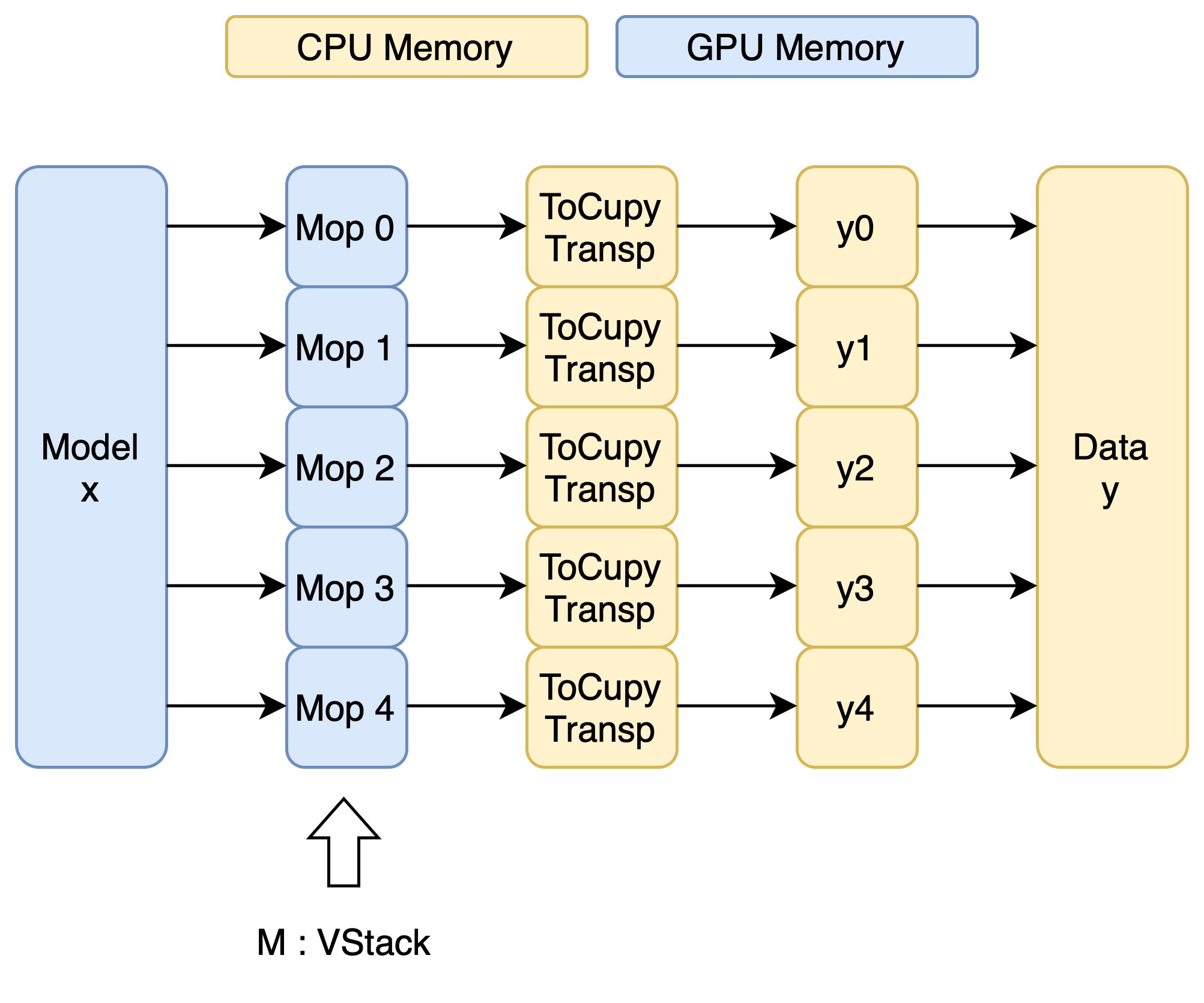
Finally, let us consider a problem where
the operator can be written as a pylops.VStack of
PyLops operators and the model vector can be fully transferred to the GPU.
We can use again the pylops.ToCupy operator, however this
time we will only use it to move the output of each operator to the CPU.
Since we are now in a special scenario, where the input of the overall
operator sits on the GPU and the output on the
CPU, we need to inform the pylops.VStack operator about this.
This can be easily done using the additional inoutengine parameter. Let’s
see this with an example.
nops, n, m = 3, 4, 5
Ms = [np.random.normal(0, 1, (n, m)) for _ in range(nops)]

# Create operator
Mops = []
for iop in range(nops):
   Mop = MatrixMult(cp.asarray(Ms[iop]), dtype=dtype)
   Top1 = ToCupy(Mop.dimsd, dtype=dtype)
   Mop = Top1.H @ Mop
   Mops.append(Mop)
Mops = VStack(Mops, inoutengine=("numpy", "cupy"))

# Create data and invert
x = cp.ones(m, dtype=dtype)
y = Mops @ x.ravel()
xest = pylops_cgls(Mops, y, x0=cp.zeros_like(x))[0]
These features are currently not available for jax arrays.
Supported Operators
In the following, we provide a list of methods in pylops.LinearOperator with their current status (available on CPU,
GPU with CuPy, and GPU with JAX):
Operator/method |
CPU |
GPU with CuPy |
GPU/TPU with JAX |
|---|---|---|---|
✅ |
🔴 |
🔴 |
|
✅ |
✅ |
✅ |
|
✅ |
✅ |
✅ |
|
✅ |
🔴 |
🔴 |
|
✅ |
✅ |
✅ |
|
✅ |
🔴 |
🔴 |
|
✅ |
🔴 |
🔴 |
Similarly, we provide a list of operators with their current status.
Basic operators:
Operator/method |
CPU |
GPU with CuPy |
GPU/TPU with JAX |
|---|---|---|---|
|
✅ |
✅ |
✅ |
|
✅ |
✅ |
✅ |
|
✅ |
✅ |
✅ |
|
✅ |
✅ |
✅ |
|
✅ |
✅ |
✅ |
|
✅ |
✅ |
✅ |
|
✅ |
✅ |
✅ |
|
✅ |
✅ |
✅ |
|
✅ |
✅ |
✅ |
|
✅ |
✅ |
✅ |
|
✅ |
✅ |
✅ |
|
✅ |
✅ |
✅ |
|
✅ |
✅ |
✅ |
|
✅ |
✅ |
✅ |
|
✅ |
🔴 |
🔴 |
|
✅ |
✅ |
✅ |
|
✅ |
✅ |
✅ |
|
✅ |
✅ |
✅ |
|
✅ |
✅ |
✅ |
Smoothing and derivatives:
Operator/method |
CPU |
GPU with CuPy |
GPU/TPU with JAX |
|---|---|---|---|
|
✅ |
✅ |
✅ |
|
✅ |
✅ |
✅ |
|
✅ |
✅ |
✅ |
|
✅ |
✅ |
✅ |
|
✅ |
✅ |
✅ |
|
✅ |
✅ |
✅ |
Signal processing:
Operator/method |
CPU |
GPU with CuPy |
GPU/TPU with JAX |
|---|---|---|---|
✅ |
✅ |
⚠️ |
|
✅ |
✅ |
✅ |
|
✅ |
✅ |
✅ |
|
✅ |
✅ |
✅ |
|
✅ |
✅ |
✅ |
|
✅ |
✅ |
🔴 |
|
✅ |
✅ |
🔴 |
|
✅ |
✅ |
✅ |
|
✅ |
✅ |
🔴 |
|
✅ |
✅ |
✅ |
|
✅ |
✅ |
✅ |
|
✅ |
✅ |
✅ |
|
✅ |
✅ |
✅ |
|
✅ |
🔴 |
🔴 |
|
✅ |
🔴 |
🔴 |
|
✅ |
🔴 |
🔴 |
|
✅ |
🔴 |
🔴 |
|
✅ |
🔴 |
🔴 |
|
✅ |
🔴 |
🔴 |
|
✅ |
✅ |
🔴 |
|
✅ |
✅ |
🔴 |
|
✅ |
✅ |
✅ |
|
✅ |
✅ |
✅ |
|
✅ |
🔴 |
🔴 |
|
✅ |
🔴 |
🔴 |
|
✅ |
✅ |
🔴 |
|
✅ |
✅ |
🔴 |
|
✅ |
✅ |
🔴 |
|
✅ |
✅ |
🔴 |
|
✅ |
✅ |
🔴 |
|
✅ |
✅ |
✅ |
Wave-Equation processing
Operator/method |
CPU |
GPU with CuPy |
GPU/TPU with JAX |
|---|---|---|---|
|
✅ |
✅ |
✅ |
|
✅ |
✅ |
✅ |
|
✅ |
✅ |
✅ |
|
✅ |
✅ |
✅ |
|
✅ |
✅ |
✅ |
|
✅ |
✅ |
✅ |
|
✅ |
✅ |
✅ |
|
✅ |
🔴 |
🔴 |
|
✅ |
🔴 |
🔴 |
Geophysical subsurface characterization:
Operator/method |
CPU |
GPU with CuPy |
GPU/TPU with JAX |
|---|---|---|---|
✅ |
✅ |
✅ |
|
✅ |
✅ |
✅ |
|
✅ |
✅ |
⚠️ |
|
✅ |
✅ |
⚠️ |
Medical:
Operator/method |
CPU |
GPU with CuPy |
GPU/TPU with JAX |
|---|---|---|---|
✅ |
✅ |
✅ |
|
✅ |
🔴 |
✅ |
Warning
1. The JAX backend of the pylops.signalprocessing.Convolve1D operator
currently works only with 1d-arrays due to a different behaviour of
scipy.signal.convolve and jax.scipy.signal.convolve with
nd-arrays.
2. The JAX backend of the pylops.avo.prestack.PrestackLinearModelling
operator currently works only with explicit=True due to the same issue as
in point 1 for the pylops.signalprocessing.Convolve1D operator employed
when explicit=False.