
 PyLops
Note
Go to the end to download the full example code.
Operators with Multithreading/Multiprocessing
This example shows how perform a scalability test for one of PyLops operators
that uses concurrent.futures/multiprocessing to spawn multiple
threads/processes. Operators that support such feature are
pylops.VStack, pylops.HStack, and
pylops.BlockDiag, and pylops.Block.
In this example we will consider the pylops.BlockDiag operator which
contains pylops.MatrixMult operators along its main diagonal.
import matplotlib.pyplot as plt
import numpy as np

import pylops

plt.close("all")
Let’s start by creating N MatrixMult operators and the BlockDiag operator
N = 100
Nops = 32
Ops = [pylops.MatrixMult(np.random.normal(0.0, 1.0, (N, N))) for _ in range(Nops)]

Op = pylops.BlockDiag(Ops, nproc=1, parallel_kind="multithread")
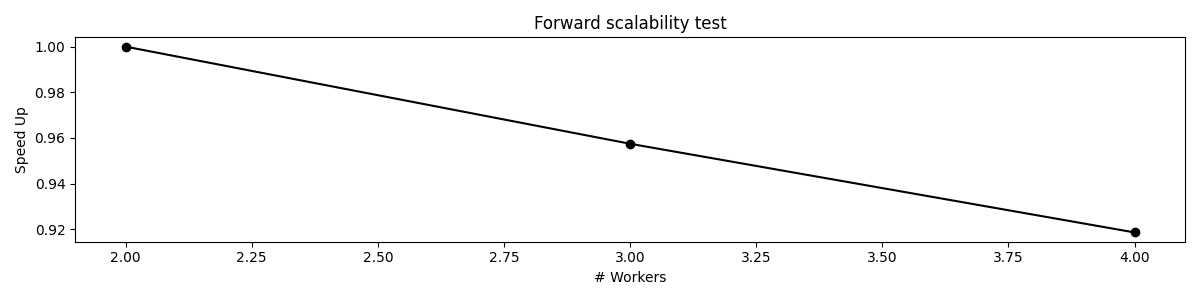
We can now perform a scalability test on the forward operation
workers = [2, 3, 4]
compute_times, speedup = pylops.utils.multiproc.scalability_test(
    Op, np.ones(Op.shape[1]), workers=workers, forward=True
)
plt.figure(figsize=(12, 3))
plt.plot(workers, speedup, "ko-")
plt.xlabel("# Workers")
plt.ylabel("Speed Up")
plt.title("Forward scalability test")
plt.tight_layout()
And likewise on the adjoint operation
compute_times, speedup = pylops.utils.multiproc.scalability_test(
    Op, np.ones(Op.shape[0]), workers=workers, forward=False
)
plt.figure(figsize=(12, 3))
plt.plot(workers, speedup, "ko-")
plt.xlabel("# Workers")
plt.ylabel("Speed Up")
plt.title("Adjoint scalability test")
plt.tight_layout()
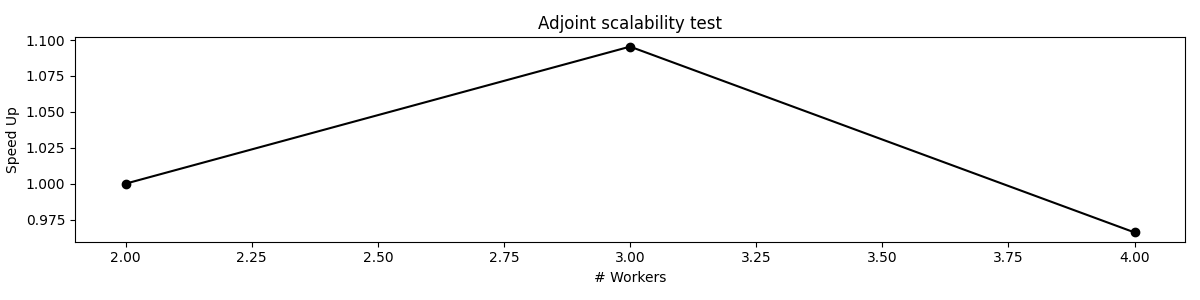
Note that we have not tested here the case with 1 worker. In this specific case, since the computations are very small, the overhead of multithreading (or multiprocessing) is actually dominating the time of computations and so computing the forward and adjoint operations with a single worker is more efficient. We hope that this example can serve as a basis to inspect the scalability of multithreading/multiprocessing-enabled operators and choose the best number of threads/processes.
Total running time of the script: (0 minutes 0.215 seconds)