 PyLops
pylops.signalprocessing.NonStationaryFilters1D
- class pylops.signalprocessing.NonStationaryFilters1D(inp, hsize, ih, dtype='float64', name='C')[source]
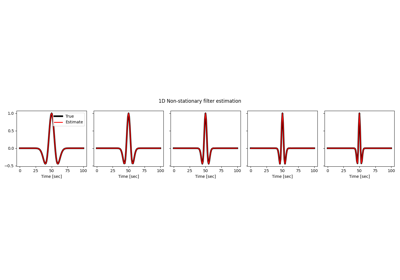
1D non-stationary filter estimation operator.
Estimate a non-stationary one-dimensional filter by non-stationary convolution. In forward mode, a varying compact filter on a coarser grid is on-the-fly linearly interpolated prior to being convolved with a fixed input signal. In adjoint mode, the output signal is first weighted by the fixed input signal and then spread across multiple filters (i.e., adjoint of linear interpolation).
- Parameters:
- inp
numpy.ndarray Fixed input signal of size \(n_x\).
- hsize
int Size of the 1d compact filters (filters must have odd number of samples and are assumed to be centered in the middle of the filter support).
- ih
tuple Indices of the locations of the filters
hsin the model (and data). Note that the filters must be regularly sampled, i.e. \(dh=\text{diff}(ih)=\text{const.}\)- dtype
str, optional Type of elements in input array.
- name
str, optional Name of operator (to be used by
pylops.utils.describe.describe)
- inp
- Attributes:
- Raises:
- ValueError
If filters
hsizeis a even number- ValueError
If
ihis not regularly sampled- ValueError
If
ihis outside the bounds defined bydims[axis]
See also
NonStationaryConvolve1D1D non-stationary convolution operator.
NonStationaryFilters2D2D non-stationary filter estimation operator.
Notes
The NonStationaryFilters1D operates in a similar fashion to the
pylops.signalprocessing.NonStationaryConvolve1Doperator. In practical applications, this operator shall be used when interested to estimate a 1-dimensional non-stationary filter given an input and output signal.In forward mode, this operator uses the same implementation of the
pylops.signalprocessing.NonStationaryConvolve1D, with the main difference that the role of the filters and the input signal is swapped. Nevertheless, to understand how to implement adjoint, mathematically we arrange the forward operator in a slightly different way. Assuming once again an input signal composed of \(N=5\) samples, and filters at locations \(t_1\) and \(t_3\), the forward operator can be represented as follows:\[\begin{split}\mathbf{y} = \begin{bmatrix} \mathbf{X}_0 & \mathbf{X}_1 & \vdots & \mathbf{X}_4 \end{bmatrix} \mathbf{L} \begin{bmatrix} \mathbf{h}_1 \\ \mathbf{h}_3 \end{bmatrix}\end{split}\]where \(\mathbf{L}\) is an operator that linearly interpolates the filters from the available locations to the entire input grid – i.e., \([\hat{\mathbf{h}}_0 \quad \mathbf{h}_1 \quad \hat{\mathbf{h}}_2 \quad \mathbf{h}_3 \quad \hat{\mathbf{h}}_4]^T = \mathbf{L} [ \mathbf{h}_1 \quad \mathbf{h}_3]\). Finally, \(\mathbf{X}_i\) is a diagonal matrix containing the value \(x_i\) along the main diagonal. Note that in practice the filter may be shorter than the input and output signals and the \(x_i\) values are placed only at the effective positions of the filter along the diagonal matrices \(\mathbf{X}_i\).
In adjoint mode, the output signal is first weighted by the fixed input signal and then spread across multiple filters (i.e., adjoint of linear interpolation) as follows
\[\begin{split}\mathbf{h} = \mathbf{L}^H \begin{bmatrix} \mathbf{X}_0 \\ \mathbf{X}_1 \\ \vdots \\ \mathbf{X}_4 \end{bmatrix} \mathbf{y}\end{split}\]Methods
__init__(inp, hsize, ih[, dtype, name])adjoint()apply_columns(cols)Apply subset of columns of operator
cond([uselobpcg])Condition number of linear operator.
conj()Complex conjugate operator
div(y[, niter, densesolver])Solve the linear problem \(\mathbf{y}=\mathbf{A}\mathbf{x}\).
dot(x)Matrix-matrix or matrix-vector multiplication.
eigs([neigs, symmetric, niter, uselobpcg])Most significant eigenvalues of linear operator.
matmat(X)Matrix-matrix multiplication.
matvec(x)Matrix-vector multiplication.
reset_count()Reset counters
rmatmat(X)Matrix-matrix multiplication.
rmatvec(x)Adjoint matrix-vector multiplication.
todense([backend])Return dense matrix.
toimag([forw, adj])Imag operator
toreal([forw, adj])Real operator
tosparse()Return sparse matrix.
trace([neval, method, backend])Trace of linear operator.
transpose()