 PyLops
pylops.waveeqprocessing.BlendingContinuous
- class pylops.waveeqprocessing.BlendingContinuous(nt, nr, ns, dt, times, shiftall=False, nttot=None, dtype='float64', name='B', **kwargs_fft)[source]
Continuous blending operator
Blend seismic shot gathers in continuous mode based on pre-defined sequence of firing times. The size of input model vector must be \(n_s \times n_r \times n_t\), whilst the size of the data vector is \(n_r \times n_{t,tot}\).
- Parameters:
- nt
int Number of time samples
- nr
int Number of receivers
- ns
int Number of sources
- dt
float Time sampling in seconds
- times
numpy.ndarray Absolute ignition times for each source
- shiftall
bool, optional Shift all shots together (
True) or one at the time (False). Defaults toshiftall=False(original implementation), howevershiftall=Trueshould be preferred whennris small.- nttot
int Total number of time samples in blended data (if
None, computed internally based on the the maximum ignition time intimes)- dtype
str, optional Operator dtype
- name
str, optional Name of operator (to be used by
pylops.utils.describe.describe)- **kwargs_fft
Added in version 2.6.0.
Arbitrary keyword arguments to be passed to the Shift operator
- nt
- Attributes:
- PadOp
pylops.basicoperators.Pad Padding operator used to add one zero at the end of each shot gather to avoid boundary effects when shifting
- shifts
listornumpy.ndarray Integer part of the time shifts (in number of samples)
- ShiftOps
listofpylops.signalprocessing.Shiftorpylops.signalprocessing.Shift Shift operator(s) used to apply the fractional part of the time shifts
- dims
tuple Shape of the array after the adjoint, but before flattening.
For example,
x_reshaped = (Op.H * y.ravel()).reshape(Op.dims).- dimsd
tuple Shape of the array after the forward, but before flattening.
For example,
y_reshaped = (Op * x.ravel()).reshape(Op.dimsd).- shape
tuple Operator shape.
- PadOp
Notes
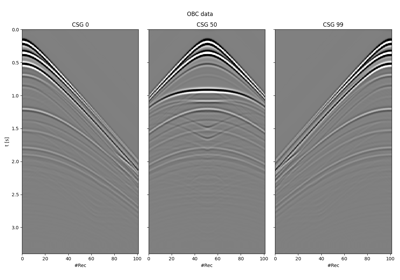
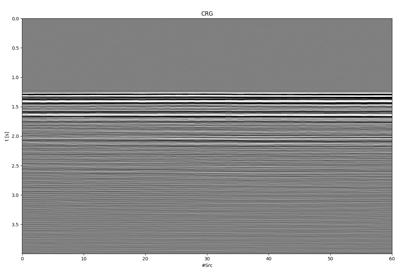
Simultaneous shooting or blending is the process of acquiring seismic data firing consecutive sources at short time intervals (shorter than the time requires for all significant waves to come back from the Earth interior).
Continuous blending refers to an acquisition scenario where a source towed behind a single vessel is fired at irregular time intervals (
times) to create a continuous recording whose modelling operator is\[\Phi = [\Phi_1, \Phi_2, ..., \Phi_N]\]where each \(\Phi_i\) operator applies a time-shift equal to the absolute ignition time provided in the variable
times.Methods
__init__(nt, nr, ns, dt, times[, shiftall, ...])adjoint()apply_columns(cols)Apply subset of columns of operator
cond([uselobpcg])Condition number of linear operator.
conj()Complex conjugate operator
div(y[, niter, densesolver])Solve the linear problem \(\mathbf{y}=\mathbf{A}\mathbf{x}\).
dot(x)Matrix-matrix or matrix-vector multiplication.
eigs([neigs, symmetric, niter, uselobpcg])Most significant eigenvalues of linear operator.
matmat(X)Matrix-matrix multiplication.
matvec(x)Matrix-vector multiplication.
reset_count()Reset counters
rmatmat(X)Matrix-matrix multiplication.
rmatvec(x)Adjoint matrix-vector multiplication.
todense([backend])Return dense matrix.
toimag([forw, adj])Imag operator
toreal([forw, adj])Real operator
tosparse()Return sparse matrix.
trace([neval, method, backend])Trace of linear operator.
transpose()