 PyLops
pylops.waveeqprocessing.PhaseShift
- pylops.waveeqprocessing.PhaseShift(vel, dz, nt, freq, kx, ky=None, dtype='float64', name='P', fftengine='numpy', **kwargs_fft)[source]
Phase shift operator
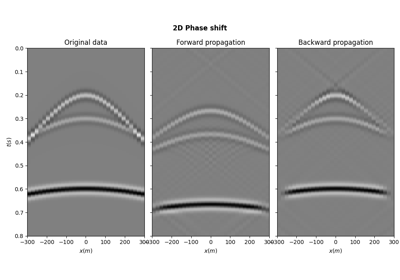
Apply positive (forward) phase shift with constant velocity in forward mode, and negative (backward) phase shift with constant velocity in adjoint mode. Input model and data should be 2- or 3-dimensional arrays in time-space domain of size \([n_t \times n_x \;(\times n_y)]\).
- Parameters:
- vel
float, optional Constant propagation velocity
- dz
float, optional Depth step
- nt
int, optional Number of time samples of model and data
- freq
numpy.ndarray Positive frequency axis
- kx
int, optional Horizontal spectroscopic wavenumber axis (centered around 0) of size \([n_x \times 1]\).
- ky
int, optional Second horizontal spectroscopic wavenumber axis for 3d phase shift (centered around 0) of size \([n_y \times 1]\).
- dtype
str, optional Type of elements in input array
- name
str, optional Added in version 2.0.0.
Name of operator (to be used by
pylops.utils.describe.describe)- fftengine
str, optional Added in version 2.6.0.
Engine used for fft computation (
numpy,scipy, orfftw). Choosenumpywhen working with CuPy arrays.- **kwargs_fft
Added in version 2.6.0.
Arbitrary keyword arguments to be passed to the selected fft method
- vel
- Returns:
- Pop
pylops.LinearOperator Phase shift operator
- Pop
Notes
The phase shift operator implements a one-way wave equation forward propagation in frequency-wavenumber domain by applying the following transformation to the input model:
\[d(f, k_x, k_y) = m(f, k_x, k_y) e^{-j \Delta z \sqrt{\omega^2/v^2 - k_x^2 - k_y^2}}\]where \(v\) is the constant propagation velocity, \(\Delta z\) is the propagation depth, \(\omega=2\pi f\) is the angular frequency axis (where \(f\) is represented by
freq), \(k_x=2\pi \tilde{k}_x\) is the horizontal wavenumber (where \(\tilde{k}_x\) is represented bykx), and \(k_y=2\pi \tilde{k}_y\) is the second horizontal wavenumber (where \(\tilde{k}_y\) is represented byky). In adjoint mode, the data is propagated backward using the following transformation:\[m(f, k_x, k_y) = d(f, k_x, k_y) e^{j \Delta z \sqrt{\omega^2/v^2 - k_x^2 - k_y^2}}\]Effectively, the input model and data are assumed to be in time-space domain and forward Fourier transform is applied to both dimensions, leading to the following operator:
\[\mathbf{d} = \mathbf{F}^H_t \mathbf{F}^H_x \mathbf{P} \mathbf{F}_x \mathbf{F}_t \mathbf{m}\]where \(\mathbf{P}\) perfoms the phase-shift as discussed above.